The restaurant seemed to stop breathing.
The young woman’s handbag lay forgotten on the floor as she hurried across the dining room, her eyes fixed on the elderly man.
“Grandpa…”
She wrapped her arms around him before he could say a word.
The old man smiled, gently patting her back.
“I thought you were in Chicago today.”
“I was.”
She laughed through tears.
“My meeting ended early.”
“I wanted to surprise you.”
She stepped back just enough to look at his face.
“Why are you standing?”
“And… where’s your soup?”
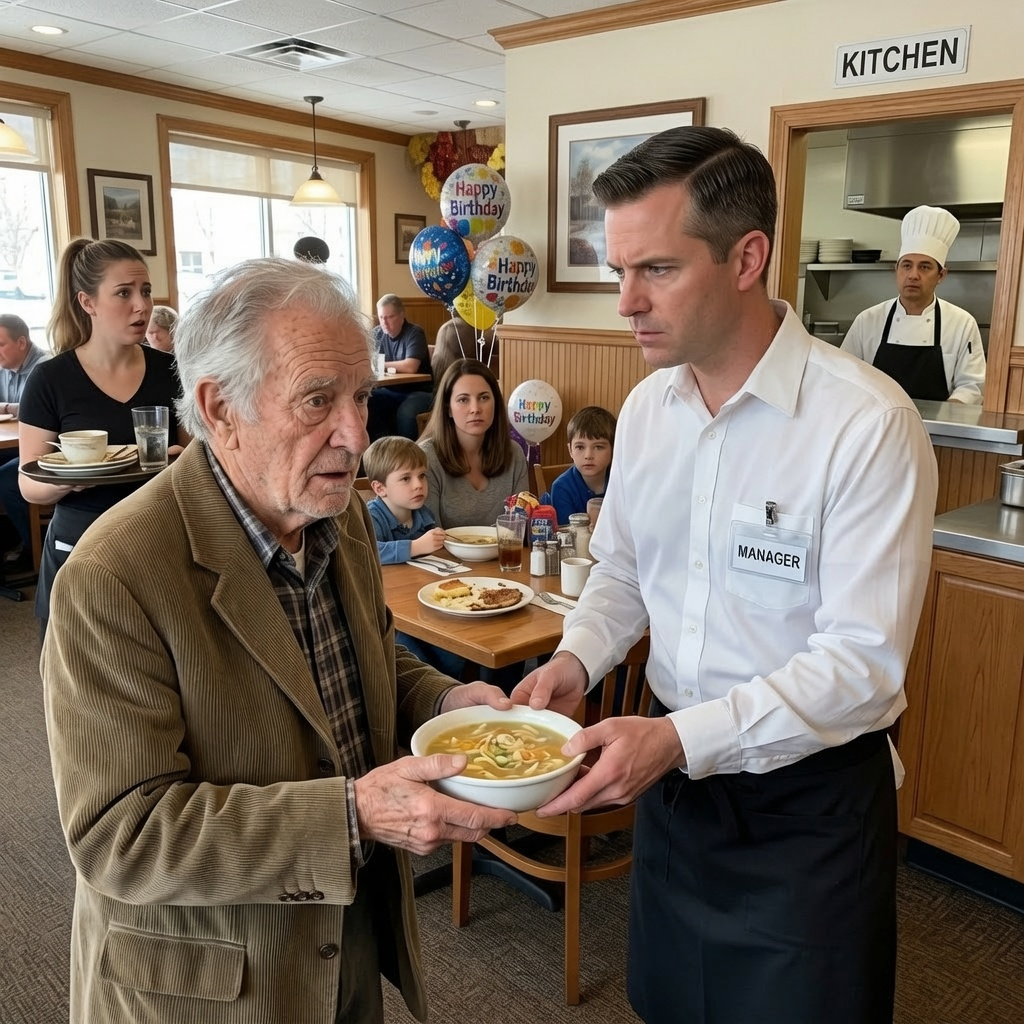
The old man glanced toward the sink.
“It’s all right.”
“I’ll order another.”
The young woman followed his gaze.
There, at the bottom of the stainless-steel sink, floated a few noodles and pieces of carrot.
Her smile disappeared.
She turned slowly toward the manager.
“What happened?”
The manager straightened his tie.
“There was a misunderstanding.”
“No,” she replied calmly.
“A misunderstanding is getting someone’s order wrong.”
She pointed toward the sink.
“That…”
“…was a choice.”
The restaurant remained silent.
The elderly man gently touched her arm.
“Emily…”
“Please.”
“It’s not worth arguing.”
She looked at him with the same expression she had worn as a little girl whenever he tried to put everyone else before himself.
“It is to me.”
She picked up the child’s drawing from the table.
The faded paper made her smile.
“You still carry this?”
“Every Friday.”
He answered without hesitation.
“You drew it.”
She laughed softly.
“I was six.”
“You told me promises grow stronger if you keep them.”
He nodded.
“I still believe that.”
She looked around the restaurant.
“When my parents were working two jobs, Grandpa was the one who picked me up from school.”
“Every Friday, we’d come here.”
“We never ordered anything fancy.”
“Just one bowl of chicken soup…”
“…and two spoons.”
A little boy at a nearby table looked up at his mother.
“Why two spoons?”
Before anyone else could answer, Emily smiled.
“Because Grandpa always said soup tastes better when it’s shared.”
Several customers smiled through misty eyes.
The manager shifted uncomfortably.
Emily continued.
“There were weeks when I thought we came because it was our tradition.”
She looked at her grandfather.
“I didn’t learn the truth until I was in college.”
The old man sighed quietly.
“You weren’t supposed to.”
She shook her head.
“He always ordered the cheapest meal…”
“…because he was saving every extra dollar for my school fund.”
She reached into her purse and pulled out a worn envelope.
Inside were dozens of folded receipts.
“I found these after Grandma organized the attic.”
“They’re every Friday lunch receipt.”
She spread them across the table.
Twenty years’ worth.
Every receipt had something written on the back in neat handwriting.
“Emily lost her first tooth today.”
“Emily got an A in spelling.”
“Emily says she wants to become an architect.”
“Emily looked sad today. Bought her an extra cookie.”
The restaurant grew impossibly quiet.
Even the chef stepped out of the kitchen to look.
Emily smiled through tears.
“Grandpa…”
“You weren’t collecting receipts.”
“You were collecting my childhood.”
The old man chuckled.
“I was afraid I’d forget the little things.”
“So I wrote them down.”
Emily gently folded the receipts again.
“I read every single one.”
“And I realized…”
“I never thanked you.”
The manager lowered his eyes.
The elderly man noticed.
“It’s all right.”
“No harm done.”
But Emily shook her head.
“Sometimes the deepest harm isn’t physical.”
She looked around the dining room.
“When someone is treated as though they don’t belong…”
“They start wondering if maybe they’re right.”
No one disagreed.
The manager slowly walked toward the table.
He stopped in front of the old man.
“I’m sorry.”
“I judged you before I knew your story.”
The old man smiled kindly.
“You judged my coat.”
“You never asked about the man wearing it.”
The manager nodded.
“You’re right.”
He turned toward the kitchen.
“A fresh bowl of soup.”
He paused.
“No.”
He looked back.
“Make it two bowls.”
The chef smiled.
“I already started.”
A few minutes later, two steaming bowls of chicken soup arrived at the table.
Emily laughed.
“We haven’t shared one in years.”
Her grandfather slid one bowl toward her anyway.
“Then let’s start again.”
They picked up their spoons at the same time.
Just like they had every Friday when she was a child.
Across the room, the birthday family quietly began clapping.
One table joined them.
Then another.
Soon, the entire restaurant filled with gentle applause.
The old man looked embarrassed.
“Oh, please…”
“You’ll make me blush.”
An elderly woman from another table stood and walked over.
“My husband passed years ago.”
She smiled warmly.
“Watching you two together reminded me to call my grandson.”
Emily reached across the table and squeezed her grandfather’s hand.
“You know…”
“I almost canceled today’s visit because of work.”
He smiled.
“I’m glad you didn’t.”
“So am I.”
She looked at the drawing again.
“I think we need a new tradition.”
The old man raised an eyebrow.
“Oh?”
“Every first Friday of the month…”
“We pay for someone else’s lunch.”
He tilted his head.
“Why?”
She smiled.
“Because somewhere in this city…”
“There’s another grandparent hoping not to eat alone.”
His eyes softened.
“I think your six-year-old heart is still in there.”
She laughed.
“You helped keep it alive.”
The following week, a small handwritten sign appeared beside the restaurant’s entrance.
It wasn’t printed.
It wasn’t polished.
It simply read:
“If you’re here to keep a promise with someone you love, you’ll always have a table.”
Below it, in smaller letters:
“And if you’re a little short today, don’t worry. Someone has already paid kindness forward.”
The manager never told customers who inspired the sign.
He didn’t have to.
Every Friday around noon, an elderly man and his granddaughter still came for chicken soup.
Sometimes they shared one bowl.
Sometimes two.
But they always shared the table.
Because they had learned long ago that the most important ingredient in any meal…
…is the person sitting across from you.