The backyard became completely silent as the family attorney carefully opened the envelope. My uncle crossed his arms with a confident smile, certain the letter would prove his point. Instead, the attorney unfolded a handwritten page and began reading. “To my family, if Thomas is reading this letter today, someone has mistaken kindness for greed. Before another word is spoken, I want everyone to understand why my granddaughter is in my will.” My grandfather quietly looked at me and smiled. The attorney continued. “She never once asked what I planned to leave her. She never asked how much my company was worth. She never asked to see my financial records. What she did ask was whether I had taken my medication, whether I needed groceries, and whether I wanted someone to watch the baseball game with me. When your grandmother died, the house became painfully quiet. She was the one who filled that silence.” Several relatives lowered their heads as they remembered how rarely they had visited over the past few years.
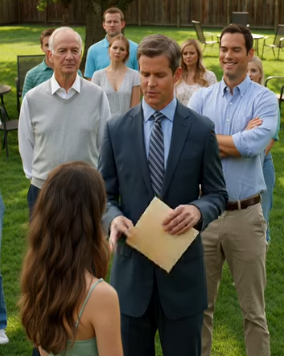
The attorney turned to the second page. “Many of you believe inheritance is a reward for sharing my last name. I disagree. An inheritance is a responsibility given to the person who understands what it took to build it.” He then opened another folder containing my grandfather’s estate documents. They revealed that while every child and grandchild would receive an equal financial inheritance, my grandfather had appointed me as the trustee of the family foundation and the caretaker of the construction company’s charitable projects. It wasn’t because I was the favorite. It was because, in his words, “She has already spent years taking care of people when there was nothing to gain from it.” My uncle immediately interrupted. “So she still gets more than the rest of us.” The attorney calmly shook his head. “No. She receives more responsibility, not more money. The position carries no additional inheritance. It carries accountability.” The room fell quiet again as everyone realized they had assumed this was about wealth when, in reality, it was about trust.
Then Grandpa slowly stood and looked directly at my uncle. “Do you know why I never told anyone about these arrangements?” he asked. My uncle didn’t answer. Grandpa continued, “Because I wanted to see who visited me after they believed there was nothing to earn.” He explained that five years earlier he had quietly told several family members he planned to donate most of his estate to charity. After that rumor spread, holiday visits became less frequent, birthday calls grew shorter, and many relatives stopped coming by altogether. I never knew about the rumor, so nothing changed. I still came every Sunday with groceries, fixed things around the house, drove him to doctor’s appointments, and stayed for dinner even when we spent the evening sitting in comfortable silence.
My uncle’s face turned red as he realized what Grandpa had done. “You were testing us?” he asked. Grandpa gently shook his head. “No. I wasn’t testing anyone. I simply stopped giving people a reason to pretend.” Those words seemed to hit everyone harder than any accusation could have. After a long silence, my uncle quietly admitted that he had convinced himself I only visited because I expected an inheritance. The truth, he confessed, was that he felt guilty for not making time for his own father, and it was easier to question my motives than to face his own absence.
Before the party ended, Grandpa asked everyone to gather for one last family photograph beneath the old oak tree. This time, he reached for my hand and smiled. “Stand beside me,” he said. “You’ve been standing beside me all these years anyway.” After the picture was taken, he handed me the envelope. On the back, he had written one final sentence in his familiar handwriting:
“The greatest legacy I can leave isn’t my money. It’s the hope that one day this family will understand that showing up is worth more than anything written in a will.”
I still keep that letter in the same wooden box where Grandpa stored old baseball tickets and family photographs. Whenever someone asks whether I inherited much from him, I always give the same answer.
I inherited the privilege of being loved by a man who taught me that the richest people are not those who leave behind the most money.
They’re the ones who leave behind the most reasons to be remembered.