The cardboard boxes hit the floor with a loud thud.
White daisies, sunflowers, and lavender stems rolled across the shop, but the young delivery woman didn’t seem to notice.
She was staring at the old man.
Tears welled in her eyes before she even realized she was crying.
“Mr. Bennett…”
The old man looked at her apologetically.
“I’m sorry…”
“I’m afraid I don’t remember your name.”
She laughed softly through her tears.
“I didn’t think you would.”
“It’s been almost twenty years.”
The florist frowned.
“You know each other?”
The young woman nodded.
“I wouldn’t be standing here if it weren’t for him.”
The customers turned their attention toward her.
She bent down, picked up one of the fallen flower boxes, then looked back at the old man.
“My name is Emma.”
“I was in your fifth-grade class.”
The old man’s face brightened.
“You were the little girl who always sat by the window.”
Emma smiled.
“And you always saved the seat for me.”
“You remembered.”
Mr. Bennett chuckled.
“I may forget names.”
“But I rarely forget kind children.”
Emma’s smile faded.
“You also remembered something else.”
The florist watched in silence.
Emma took a slow breath.
“When I was ten…”
“My mom lost her job.”
“We couldn’t pay rent.”
“There were days when my little brother and I came to school without breakfast.”
Mr. Bennett lowered his eyes.
“I remember.”
Emma continued.
“You never asked questions.”
“You never embarrassed us.”
“Every Monday, Wednesday, and Friday…”
“…you’d tell the class someone had donated extra lunches.”
She smiled sadly.
“There was never any donor, was there?”
The old man looked almost embarrassed.
“I didn’t want anyone to feel ashamed.”
Emma laughed quietly.
“I found out years later.”
“You paid for every lunch yourself.”
Several customers glanced at the old man’s worn coat.
It was difficult to imagine that the gentle man standing before them had once spent his own salary feeding hungry children.
Emma looked around the flower shop.
“He did that for three years.”
“He bought notebooks.”
“Winter coats.”
“School shoes.”
“But he always made us believe they came from someone else.”
One customer whispered,
“Why?”
Mr. Bennett answered before Emma could.
“Children should never feel like charity.”
“They should feel like they belong.”
The words settled over the shop.
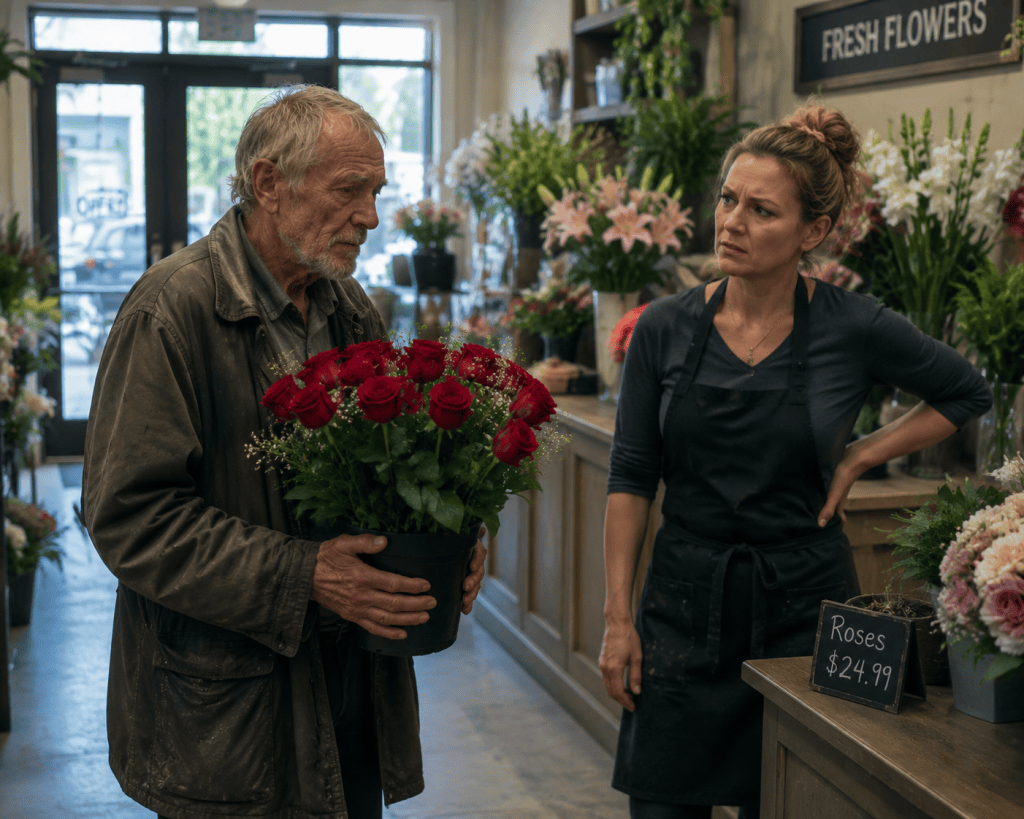
The florist slowly looked toward the bucket where the roses still lay upside down.
For the first time that morning…
She felt ashamed of how quickly she had judged the man standing before her.
Emma turned back to Mr. Bennett.
“I became a florist because of you.”
He blinked.
“Because of me?”
She nodded.
“Every spring, you filled the classroom with flowers.”
“You said…”
She smiled.
“‘A room with flowers reminds people tomorrow is coming.'”
The old man laughed.
“I really said that?”
“You did.”
“And after everything my family went through…”
“I needed to believe tomorrow was coming.”
A quiet silence followed.
Emma walked to the display, picked up the bouquet of six roses, and gently placed it back into Mr. Bennett’s hands.
“These are yours.”
He immediately shook his head.
“I still don’t have enough.”
“I know.”
She smiled.
“You already paid.”
He looked confused.
“When?”
“Twenty years ago.”
She paused.
“With hundreds of lunches.”
The florist quickly stepped forward.
“No.”
Her voice trembled.
“They’re not from Emma.”
She looked directly at the old man.
“They’re from the shop.”
Mr. Bennett smiled politely.
“I appreciate it.”
“But I don’t accept free things.”
The florist swallowed.
“They aren’t free.”
“They’re an apology.”
The old man remained quiet.
The florist continued.
“When my father lost his business…”
“My teacher quietly bought my school supplies.”
“I never knew who it was.”
She looked at him.
“I spent years telling myself…”
“If I ever met someone that kind…”
“I’d thank them.”
A tear rolled down her cheek.
“Instead…”
“I embarrassed you.”
The old man gently shook his head.
“No.”
“You judged my clothes.”
“You didn’t judge my heart.”
“Those are two different mistakes.”
The florist covered her face for a moment.
“I still made them.”
Mr. Bennett smiled kindly.
“Then today is a good day to become someone better.”
No one in the shop spoke.
Sometimes forgiveness leaves a room quieter than anger ever could.
Emma noticed the small cloth handkerchief still peeking from the old man’s pocket.
“May I ask something?”
He nodded.
“Why six roses?”
Mr. Bennett’s smile returned.
“When my wife and I were newly married…”
“I could only afford six.”
“I apologized because I couldn’t buy a dozen.”
He laughed softly.
“She told me…”
“‘I’d rather have six roses from the man I love than a hundred from someone who doesn’t know my name.'”
He looked at the bouquet.
“So I never bought twelve.”
“Not once in fifty-three years.”
Even the florist smiled through her tears.
Late that afternoon, Mr. Bennett arrived at the nursing home.
The receptionist greeted him warmly.
“She’ll be happy you’re here.”
He nodded.
“I hope so.”
His wife was sitting near the window, watching birds gather around a small fountain.
She looked at him with the polite smile reserved for strangers.
“Good afternoon.”
He smiled back.
“Good afternoon.”
He never corrected her.
He simply sat beside her, exactly as he had every Friday.
He placed the six roses in the vase by her chair.
For several seconds, she stared at them.
Then she leaned closer.
She closed her eyes and breathed in their fragrance.
A faint smile appeared.
Without looking at him, she whispered,
“You remembered…”
Mr. Bennett’s eyes filled instantly.
“I always will.”
She reached for one rose.
Then, almost absentmindedly, she tucked it into the buttonhole of his old coat.
“There.”
She smiled.
“My handsome husband shouldn’t bring flowers…”
“…without taking one home too.”
She no longer remembered his name.
She no longer remembered the street where they had raised their children.
She no longer remembered what year it was.
But somehow…
Somewhere beyond memory…
Her heart still remembered how to love him.
Outside the room, Emma had just finished delivering flowers to another resident.
She paused at the doorway.
She watched the elderly couple sitting together in comfortable silence.
Neither noticed she was there.
She quietly turned away, smiling.
The next morning, a small wooden sign appeared beside the entrance of the flower shop.
It read:
“If your flowers are for someone you love, don’t leave because you’re a little short. Come inside anyway.”
The florist never advertised the sign.
She never posted it online.
But from that day forward, no one was ever turned away before being asked,
“Who are the flowers for?”
Because she had finally learned what Mr. Bennett had understood all along.
The true value of a bouquet…
…isn’t measured by its price.
It’s measured by the person waiting to receive it.