For several long seconds, no one moved.
The envelope rested in the middle of the conference table like something far heavier than paper. It was yellow with age, its corners softened by decades of careful handling. Ryan stared at it without reaching for it. He didn’t believe in family legends, old promises, or sentimental stories. He believed in quarterly earnings, acquisition deals, and shareholder confidence. Whatever was inside that envelope, he had already decided it couldn’t possibly matter.
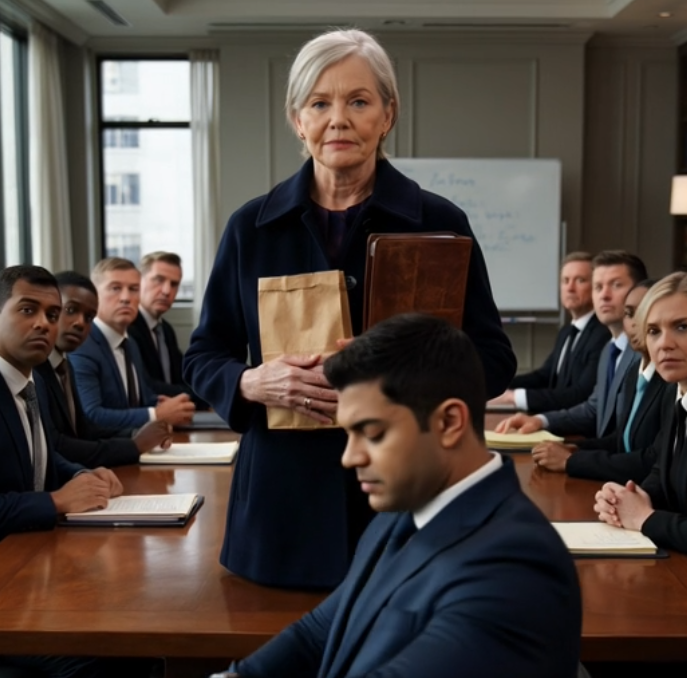
Eleanor, on the other hand, looked relieved.
Not because Ryan had accepted the letter.
But because after thirty years, she no longer had to carry it alone.
Ryan finally broke the silence.
“My father asked you to keep a letter from me?”
Eleanor nodded.
“He asked me to destroy it.”
“So why didn’t you?”
She smiled sadly.
“Because he changed his mind.”
Ryan frowned.
“When?”
“The day before he died.”
The room remained silent.
Everyone in the boardroom knew that Harold Whitmore, the company’s former chairman, had passed away two years earlier after a brief illness. His funeral had been attended by politicians, business leaders, and television cameras. Newspapers described him as a visionary who built one of the country’s most respected manufacturing companies.
No newspaper had mentioned Eleanor.
No one had asked where she sat during the service.
The truth was, she hadn’t sat anywhere near the front.
She had stood quietly beneath a tree outside the cemetery until everyone else had gone home.
Ryan picked up the envelope.
The seal had never been broken.
His father’s handwriting stretched across the front.
“To my son. Only when you’re ready to know who really built your future.”
Ryan looked up.
“What does that mean?”
Eleanor answered gently.
“It means your father wanted you to admire him.”
“But before he died…”
“He wanted you to understand him.”
Ryan slowly opened the envelope.
Inside was a handwritten letter spanning several pages.
He unfolded the first sheet.
His father’s writing was unmistakable.
“Ryan… if you’re reading this, then Eleanor has decided the time for protecting my pride is over.”
Ryan’s heartbeat quickened.
“Everything people believe about how this company survived its first years is incomplete.”
He kept reading.
“The newspapers called me courageous.”
“The board called me brilliant.”
“Employees thanked me for saving their jobs.”
“But none of them knew the truth.”
Ryan’s eyes moved faster.
“I did not save the company.”
“Your Aunt Eleanor did.”
The room became impossibly still.
Ryan looked up.
“No.”
Eleanor remained quiet.
Ryan continued reading.
Thirty-four years earlier, the company had been drowning in debt. Suppliers refused to deliver materials. Banks had rejected every request for another loan. Payroll was only days away from collapsing.
Harold had gone home that night prepared to tell his employees the company was finished.
Instead…
Eleanor quietly disappeared into their bedroom.
She returned carrying a small metal box.
Inside were family heirlooms.
Her wedding jewelry.
The necklace her mother had left her.
The earrings her grandmother had worn on her wedding day.
Even her engagement ring.
“Sell them,” she had told Harold.
“Businesses can be rebuilt.”
“People’s dignity cannot.”
Ryan stopped reading.
His hands had begun to tremble.
He looked at Eleanor.
“You sold everything?”
She smiled faintly.
“They were only things.”
Ryan whispered,
“Why did no one ever tell me?”
Eleanor looked toward the large company logo mounted on the wall.
“Because your uncle couldn’t bear the thought that history would remember him as the man who needed his wife’s sacrifice.”
Ryan lowered his eyes.
He continued reading.
The letter became even more painful.
It revealed that Eleanor had secretly worked nights sewing clothes for a local factory to help pay employees when the company couldn’t.
She skipped meals so their daughter could eat.
She pawned the family piano.
When Harold wanted to give up…
She refused.
“If one hundred families lose their income because we were too proud to ask for help,” she had told him, “then this company doesn’t deserve to survive.”
Ryan remembered something.
When he was eight years old, he had asked his father why Aunt Eleanor always took the bus instead of driving.
His father had laughed.
“Some people are simply too stubborn to spend money.”
Ryan suddenly understood.
She wasn’t stubborn.
She simply never had anything left to spend.
His chest tightened.
The final pages of the letter were stained with faded tear marks.
“Ryan…”
“There’s one more truth.”
“The shares everyone believes I purchased during those difficult years…”
“I never bought them.”
Ryan looked up sharply.
“What?”
Eleanor quietly removed another envelope from her folder.
“I think this belongs with the first.”
Inside was the original stock certificate.
Signed.
Dated.
Not in Harold Whitmore’s name.
In Eleanor Whitmore’s.
She had become the company’s largest shareholder thirty-one years earlier.
Ryan stared at the document in disbelief.
“You…”
“…owned the company?”
Eleanor nodded.
“Legally.”
“But I never wanted control.”
“So I transferred every voting right to your uncle.”
One executive finally spoke.
“Mrs. Whitmore…”
“Why would you do that?”
She answered without hesitation.
“Because he cared about building the company.”
“I cared about protecting the people inside it.”
The room fell silent again.
Ryan felt sick.
His entire life had been built on a story that wasn’t true.
His father hadn’t stolen anything.
But he had allowed the world to believe a version of history that left Eleanor invisible.
Ryan looked around the boardroom.
Every portrait hanging on the wall showed former chairmen.
Every annual report praised Harold’s leadership.
The lobby downstairs featured a bronze statue of him.
There wasn’t a single photograph of Eleanor anywhere in the building.
Not one.
Ryan slowly stood.
Without saying a word, he walked to the wall displaying the company’s founding timeline.
He stared at it for several seconds.
Then turned back toward the executives.
“Cancel my meetings.”
No one questioned him.
He looked at the head of corporate communications.
“How long would it take to redesign the lobby?”
The woman blinked.
“A few weeks.”
Ryan shook his head.
“You have until Monday.”
He turned to the facilities director.
“The founder’s exhibit.”
“I want every archive, photograph, and financial record reviewed.”
“Every contribution Eleanor made…”
“…goes back into this company’s history.”
Eleanor quietly interrupted.
“Ryan.”
He looked at her.
“I didn’t come here for recognition.”
“I know.”
“Then why are you doing this?”
Ryan’s voice cracked for the first time in years.
“Because I spent two years trying to become the man my father wanted me to be.”
He held up the letter.
“And today I discovered…”
“…the person I should have been trying to become…”
He looked directly at her.
“…was you.”
Eleanor lowered her head.
A tear escaped before she could stop it.
Ryan walked around the conference table.
The executives instinctively stepped aside.
When he reached her, he noticed the paper bag still sitting exactly where she had left it.
He opened it.
Inside were homemade oatmeal cookies.
Still warm.
He smiled through watery eyes.
“Dad really loved these?”
Eleanor laughed softly.
“He always ate two before pretending he only wanted one.”
The room chuckled.
The tension finally eased.
Ryan picked up a cookie.
He took one bite.
Closed his eyes.
Then whispered,
“They taste like home.”
Eleanor smiled.
“They always did.”
The following month, employees arriving at headquarters noticed something different.
The bronze statue in the lobby was still there.
Harold Whitmore remained part of the company’s history.
But beside it stood another statue.
Not larger.
Not higher.
Equal.
It showed Eleanor holding not a briefcase…
Not a contract…
Not money…
But a simple lunchbox.
The same lunchbox she had carried during years of working two jobs to keep strangers employed.
Beneath the statue, a new plaque read:
“Great companies are often remembered for the people who lead them. They survive because of the people willing to sacrifice everything without asking to be remembered.”
Ryan insisted those words remain unsigned.
When reporters asked who had written them, he always gave the same answer.
“They weren’t written.”
“They were lived.”