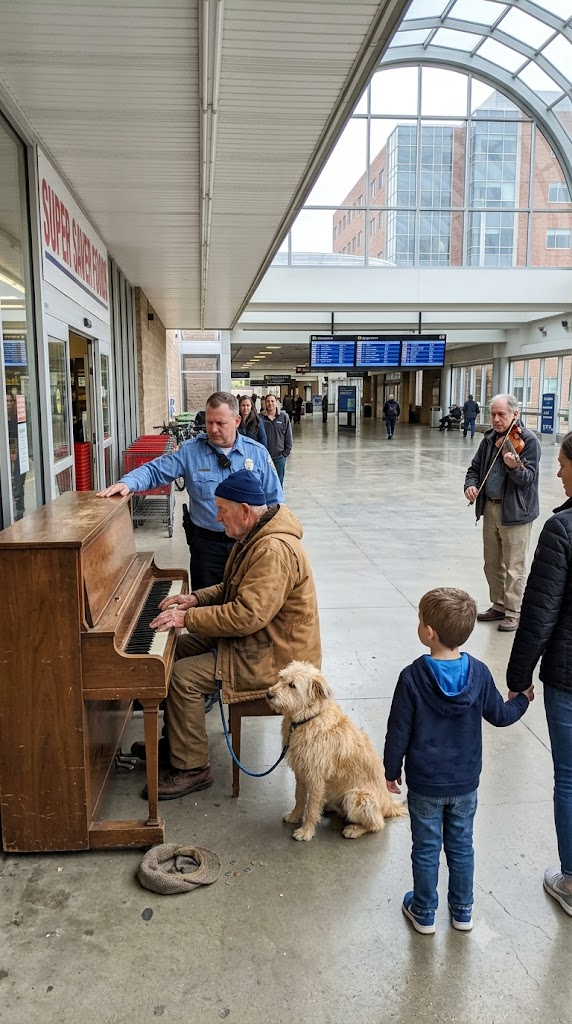
Mr. Bennett accepted the envelope with trembling hands. The paper had been folded carefully, and on the front, written in slightly shaky handwriting, were just three words:
“For my pianist.”
A quiet smile appeared on his face before he opened it.
Inside was a short note.
“If my window is open, I’ll be listening. If it’s closed, keep playing anyway. I’ll still hear you with my heart.”
For a moment, he simply looked at the words without speaking. The station around him seemed to disappear.
The hospital volunteer smiled gently. “She made me promise to bring you that before noon. She said you always worry if she doesn’t wave from the window.”
Mr. Bennett laughed softly.
“I do.”
“She never misses our Friday concert.”
The security guard lowered his eyes. For the first time, he noticed the small notebook tucked under the old man’s arm. Its cover was faded from years of use.
“What is that?” he asked quietly.
The old man opened it.
Every page contained the same thing.
A date.
The title of a song.
And a tiny checkmark beside it.
“I’ve written down every Friday concert we’ve shared.”
He turned another page.
“There were Fridays in parks.”
“Fridays outside libraries.”
“Fridays in retirement homes.”
Then he stopped on the newest page.
Friday — Hospital Window.
“No checkmark yet,” he said with a smile. “Today’s concert hasn’t happened.”
The young woman who had spoken to him earlier felt tears sting her eyes.
“You’ve really been doing this all these years?”
Mr. Bennett nodded.
“We promised each other something when we got married.”
“What was that?”
“No matter how life changed…”
“…we’d never stop making ordinary Fridays feel special.”
The station remained silent.
People weren’t waiting for trains anymore.
They were waiting for the concert.
The security guard took a slow breath before walking over to the piano. Without saying a word, he lifted the lid he had slammed shut only minutes earlier. Then he stepped back.
“I’m sorry,” he said quietly.
“I thought you were asking strangers for money.”
Mr. Bennett smiled.
“I wasn’t.”
“I was keeping a date.”
The guard looked at the coins still scattered among the passengers.
He gently shook his head.
“No more interruptions.”
“This station could use a little more music.”
At that moment, several nurses appeared along the glass walkway connecting the station to the hospital. One by one, they opened the windows overlooking the atrium.
Near the center window, an elderly woman slowly raised her hand.
She looked small beneath her hospital blanket.
But the smile on her face was unmistakable.
Mr. Bennett saw her immediately.
“There you are,” he whispered.
He sat at the piano.
No announcement.
No applause.
His fingers simply found the keys as though they had been waiting all week for this moment.
The melody floated through the station, climbed the glass walls, and drifted toward the open hospital windows. Travelers stopped checking departure boards. Children sat quietly on the floor. Even the café staff paused their work, letting the music fill the building.
Halfway through the piece, Mrs. Bennett closed her eyes.
She wasn’t watching him anymore.
She was remembering.
Remembering tiny apartments where they had danced barefoot after dinner.
Remembering park benches where he played on old community pianos.
Remembering Fridays that had never been expensive, but had always been rich.
When the final note faded, no one clapped immediately.
The silence itself felt like part of the music.
Then, somewhere near the back of the station, one person began to applaud.
Another joined.
Soon the entire hall echoed with warm, heartfelt applause—not for a performance, but for a promise that had lasted a lifetime.
Mr. Bennett didn’t bow.
He simply looked toward the hospital window.
Mrs. Bennett placed her hand over her heart.
Then she mouthed three familiar words.
“See you Friday.”
He smiled and answered the same way he always had.
“I’ll be here.”
In the weeks that followed, the station manager made a quiet decision. Every Friday at noon, the public piano would be reserved for one hour. No permits. No performances for profit. Just a simple sign resting on the music stand:
“Reserved for promises that deserve to be heard.”
Passengers often asked why that hour was protected.
The staff would simply smile and say, “Because some concerts are not meant to entertain a crowd.”
“They’re meant to remind one person that, somewhere nearby, someone is still keeping the promise they made… one ordinary Friday at a time.”