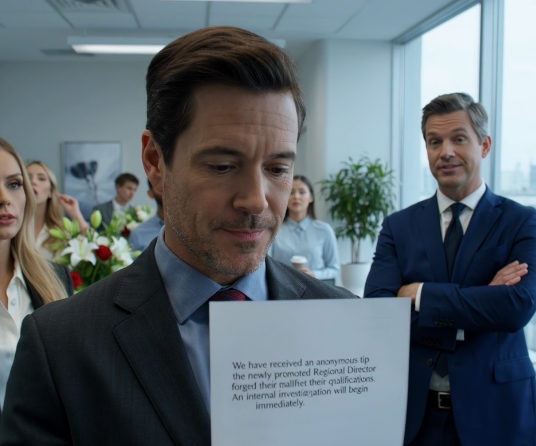
The conference room fell silent as the HR director carefully opened the envelope. Richard’s confident expression disappeared almost immediately. He leaned forward and asked, “Why are you opening that now?” The HR director answered calmly, “Because these were your written instructions.” She unfolded the letter and began reading.
“If this letter is ever opened, it means someone has questioned whether my successor earned this position. If that happens, I want the company to know one thing immediately: the person who replaces me will have earned it on merit, not because of my recommendation or anyone else’s influence.”
I looked at Richard in disbelief.
The letter continued.
“Over the past several years, I have deliberately assigned my successor the most difficult accounts in the company. Every promotion they received was supported by independently verified performance reviews, successful audits, and measurable business results. If anyone ever claims otherwise, they are questioning decisions that I personally approved.”
The HR director placed the letter on the table.
Then she looked at the anonymous documents.
“There is another issue.”
She explained that the certification numbers attached to the anonymous email had already been verified with the issuing organizations. Every certificate in my personnel file was authentic. The forged versions sent in the complaint had been digitally altered, and the metadata showed they had been created only a few days earlier.
The company’s IT director, who had joined the meeting midway through, quietly added, “We’ve also traced the anonymous email.”
Richard shifted uncomfortably.
“It wasn’t sent from the new director’s account.”
He paused.
“It was sent from a temporary email created on a laptop that logged into the company guest network on Friday evening.”
Everyone in the room turned toward Richard.
The CEO frowned.
“Friday evening…”
Richard had been in the building that evening to “clear out his office.”
HR asked him directly if he knew anything about the email.
For several long seconds, he said nothing.
Then he sighed.
“I didn’t think it would go this far.”
The room went still.
He admitted that after learning I would replace him, he couldn’t accept the idea that the company was moving on without him. He convinced himself that if the promotion were delayed, the board might reconsider and ask him to stay as a consultant. In his frustration, he created the anonymous complaint, believing it would only trigger a routine review—not realizing the evidence would quickly expose the deception.
The CEO looked disappointed more than angry.
“You spent ten years teaching future leaders.”
He shook his head.
“And in one weekend, you almost destroyed one.”
Richard quietly apologized.
Not just to me.
But to every executive in the room for betraying the trust they had placed in him.
The company completed its investigation, officially cleared my name, and announced my promotion to the entire organization. At the next staff meeting, the CEO stood beside me and said, “A person’s reputation takes years to build and minutes to attack. Today we’re celebrating someone whose integrity survived both.”
Months later, I moved into the office that had once belonged to Richard. Most of the furniture had been replaced, but one item remained: a small wooden plaque he had forgotten to take with him. On the back, someone had handwritten a quote years earlier.
“The greatest measure of a leader is not who succeeds them. It’s whether they help that successor stand even taller.”
I left the plaque on the bookshelf as a reminder.
Not of Richard’s mistake.
But of the kind of leader I wanted to become.