The birthday celebration began with laughter, family photos, and dozens of employees who had worked alongside my grandfather for decades. Ryan walked around the room with confidence, shaking hands and accepting congratulations as if the company already belonged to him. He even introduced himself to several guests as “the next person responsible for continuing Grandpa’s legacy.” I said nothing. I simply stood beside my grandfather, waiting for him to speak.
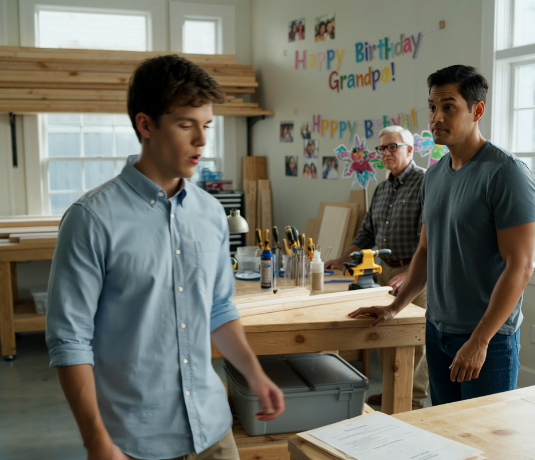
When everyone had gathered, Grandpa slowly walked to the front of the room. He looked older than usual, but his voice was still strong. “Today isn’t just my birthday,” he said. “It’s also the day I want to clear up something that has been misunderstood for a long time.” Ryan smiled proudly, expecting his name to be announced.
Instead, Grandpa looked at me.
“For ten years, I watched two people in this family approach my company in completely different ways. One saw it as something to inherit. The other saw it as something to protect.”
The room became quiet.
Grandpa explained that he had never promised the business to anyone based on age, bloodline, or family expectations. He had created a leadership evaluation years earlier, secretly watching how each person treated employees, handled problems, and responded when no one was watching. Ryan had focused on titles and ownership. I had focused on the people who made the company successful.
Then Grandpa asked his attorney to step forward.
The attorney opened a folder containing the official documents.
“The ownership transfer has already been completed,” he announced. “Mr. Anderson has chosen the person who will become the next majority owner and CEO of the company.”
Ryan immediately stood up.
“I know. It’s me.”
The attorney looked at him calmly.
“No, Mr. Ryan.”
The room froze.
“It is Emma.”
Ryan’s expression changed instantly.
“That’s impossible.”
Grandpa looked at him sadly.
“No, what was impossible was believing that my last name mattered more than my values.”
Ryan tried to argue.
“But I’m your grandson.”
Grandpa nodded.
“Yes. And I love you.”
He paused.
“But love does not mean ignoring someone’s actions.”
He explained that a few weeks earlier, Ryan had secretly attempted to remove experienced employees and replace them with people who would answer only to him. He had also pressured suppliers to sign agreements that benefited him personally. Grandpa had discovered everything.
“You didn’t want to continue my legacy,” Grandpa said. “You wanted to own it.”
Ryan lowered his head.
After the announcement, several employees came to congratulate me. But the moment I remember most was when Grandpa took my hand and whispered, “I hope you know I didn’t choose you because you worked harder than everyone else. I chose you because you understood why the work mattered.”
Years later, the company continued growing. I kept many of Grandpa’s traditions, including the one he valued most: every employee, from the newest worker to the oldest manager, was invited to share ideas directly with leadership.
Ryan eventually apologized. It took time, but he admitted that jealousy had made him believe he deserved something simply because of his family name. He said watching me lead the company taught him a lesson he should have learned years earlier.
On the wall of my office, I hung a photograph of Grandpa standing in his old workshop.
Below it was a sentence he wrote by hand:
“A legacy is not something you receive because you are family. It is something you prove you can protect.”
And every time I looked at those words, I remembered that my grandfather didn’t leave me a company.
He left me a responsibility.