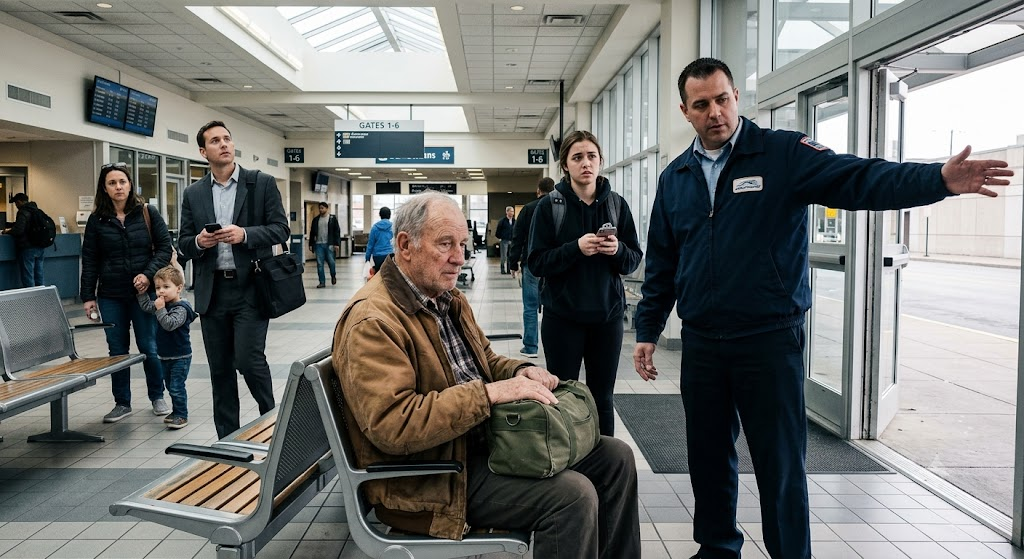
Mr. James looked up at the teenage boy standing in front of him and smiled with surprise. “You found her?” he asked. The boy nodded excitedly. “Yes. She works at the community center near my school. She said she can help my mom find a new job.” The people around the station listened quietly, still trying to understand how a simple old man sitting on a bench had become connected to so many lives.
The bus station worker looked at the notebook again. “Wait… is this what you do every day? You just sit here and connect people?” Mr. James smiled. “I don’t connect people. I just pay attention.” He opened the notebook and pointed to the boy’s name. “Ethan came here three months ago. He was sitting alone, pretending to do homework, but he hadn’t eaten lunch.” The teenager looked embarrassed. “You noticed that?” Mr. James laughed softly. “You threw away your sandwich wrapper without eating anything. It wasn’t difficult to notice.” Ethan smiled. “He bought me lunch that day.” Mr. James shook his head. “No. I shared my lunch.” “There is a difference.”
The woman waiting nearby asked, “And after that, you helped him find someone from the community center?” Ethan nodded. “My mom lost her job. She didn’t know where to ask for help. Mr. James said there was always someone who knew the next step.” The old man smiled. “Sometimes people don’t need someone to solve their problems. Sometimes they just need someone to show them where the next door is.”
The station worker slowly looked around the waiting area. Suddenly, he saw things differently. The old woman sitting alone near the ticket machine wasn’t just an old woman. The man staring at his phone wasn’t just another passenger. The young mother trying to calm her crying child wasn’t just someone making noise. They were all people carrying stories that strangers rarely noticed.
The worker cleared his throat. “Mr. James…” The old man looked up. “Yes?” He hesitated. “Why didn’t you tell me this when I asked you to leave?” Mr. James smiled. “Would it have changed anything?” The worker opened his mouth, then stopped. He knew the answer. A person shouldn’t need to prove their worth before being treated with respect.
“I’m sorry,” the worker said quietly. “I thought you were taking up space.” He looked at the bench. “I didn’t realize you were creating a place where people felt welcome.”
Mr. James smiled. “A bench is just wood and metal.” “It becomes something more when someone decides to sit beside another person.”
The next morning, something unusual happened at the bus station. A small table appeared beside the bench with a sign placed on top.
“Need directions? Need someone to talk to? Need a little help finding the next step?”
Nobody knew who had placed it there.
But everyone suspected it was the station worker.
At first, only a few people stopped by. Then more came. Someone needed information about job applications. Someone needed directions to a hospital. Someone simply needed five minutes of conversation after a difficult morning.
And every day at eight o’clock, Mr. James still arrived with his notebook.
Years later, the city newspaper wrote an article about the “kindness bench” that had quietly changed the bus station. They interviewed dozens of people whose lives had been touched by a stranger who simply noticed them.
When the reporter asked Mr. James why he started doing it, he gave the same answer he had given years before.
“I spent a long time thinking being forgotten was the worst feeling in the world.”
“Then I realized something.”
“The opposite of loneliness isn’t having a thousand friends.”
“It’s knowing that, somewhere, someone would notice if you weren’t there.”
The reporter asked him what was written on the last page of his notebook.
Mr. James smiled and closed it.
“That page is for tomorrow.”
“Because there is always someone new who needs to be seen.”
And every morning at eight o’clock, the old man returned to the same bench—not because he had nowhere else to go…
But because he knew someone else might need somewhere to belong.