The elderly woman held the bouquet tightly as she walked toward the bench, her face lighting up with relief the moment she found the old man.
“There you are,” she said with a smile. “I thought I’d missed our lesson.”
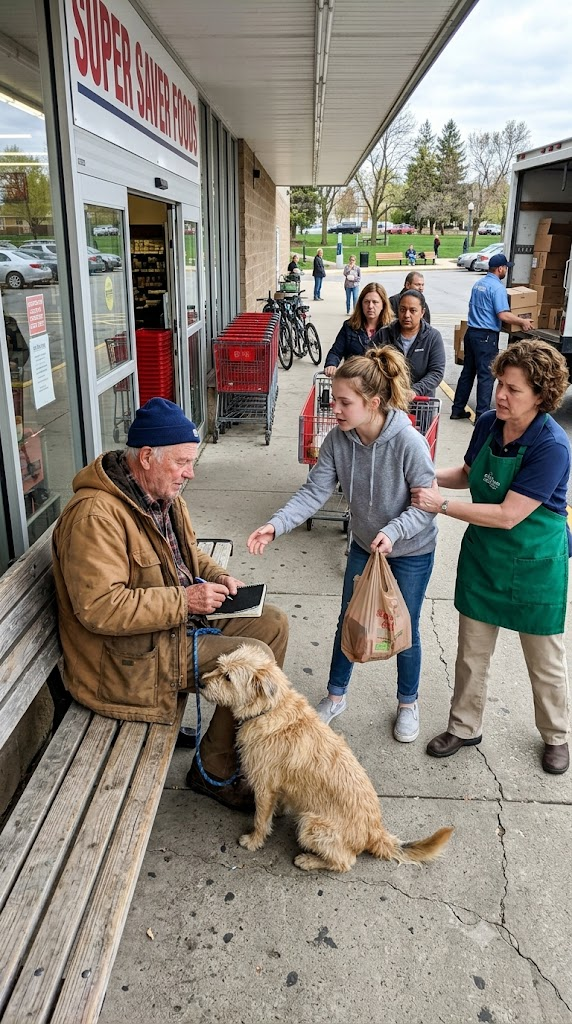
The grocery store owner looked from one person to the other in confusion.
“Lesson?”
The old man smiled modestly. “Mrs. Lewis lost most of her eyesight a few years ago. Her husband used to write her a letter every anniversary. After he passed away, she stopped opening them because she couldn’t read them anymore. We started meeting every Wednesday so I could read one aloud.”
Mrs. Lewis nodded. “He never skips a Wednesday. Not once.”
The teenage girl looked at the notebook again. Suddenly, every name on the pages made sense.
The owner still seemed skeptical. “Reading letters doesn’t explain why all these people are written down.”
Before the old man could answer, another voice called from across the street.
“Mr. Harris!”
A middle-aged man in a mechanic’s uniform jogged toward them carrying a toolbox.
“I’ve been looking everywhere for you.”
He reached into his pocket and handed the old man a neatly folded envelope.
“I finally got the promotion.”
The old man smiled as though it were his own good news.
“I knew you would.”
The mechanic laughed.
“You don’t understand.”
He turned toward the people gathered outside the store.
“Five years ago I lost my job. I was sleeping in my truck because I couldn’t afford rent. Every morning this man sat beside me with two cups of coffee.”
The owner frowned.
“You knew him back then?”
“I didn’t.”
“That’s the strange part.”
The mechanic shook his head with a smile.
“He introduced himself, asked me what kind of work I did, and spent three weeks helping me rewrite my résumé at the public library.”
He laughed.
“I complained the entire time.”
The crowd smiled.
“But he kept saying, ‘A bad season isn’t the end of the story.'”
The mechanic looked at the old man.
“I got my next job because of that résumé.”
He placed the envelope into the old man’s hands.
“It’s my first bonus.”
“I wanted you to have part of it.”
The old man immediately tried to hand it back.
“You have a family now.”
“They need it more.”
The mechanic smiled.
“They already have what they need.”
“Because someone refused to walk past a stranger sitting alone.”
Before the old man could respond, another familiar voice interrupted.
Then another.
Within minutes, people began arriving from different directions as though an invisible invitation had been sent across the neighborhood.
A college student carrying groceries.
A postal worker still wearing his uniform.
An elderly couple walking hand in hand.
A young mother pushing a stroller.
Each of them greeted the old man by name.
Each had a different story.
“He taught my daughter to read while I worked night shifts.”
“He fixed my fence after the storm.”
“He visited my husband in the hospital every weekend.”
“He walked my dog for three months after my hip surgery.”
The grocery store owner stood speechless.
He had assumed the old man spent his days asking for help.
Instead, he discovered that the old man had quietly spent years becoming the person everyone else depended on.
The teenage girl gently picked up the bag of groceries that had started the whole misunderstanding and placed it beside the old man.
“This is still for you.”
The old man smiled.
“Then let’s share it.”
He looked around at the people standing together.
“I don’t think anyone should eat alone today.”
Someone laughed.
“I brought sandwiches.”
“I’ve got fruit.”
“I made soup this morning.”
Within minutes, what had begun as an uncomfortable confrontation turned into an impromptu picnic in the small park across the street.
The grocery store owner watched from a distance before quietly disappearing inside.
A few minutes later, he returned carrying folding chairs, bottled water, and several boxes of fresh bread.
He placed everything on the grass without saying a word.
The old man looked up.
“You don’t have to do this.”
The owner smiled sheepishly.
“I know.”
“But I’d like to.”
He paused before adding, “For years I thought wealth was measured by what people kept.”
He looked around at the circle of smiling faces.
“You’ve shown me it’s measured by how many people would stop what they’re doing just to sit beside you.”
The old man laughed softly.
“I’ve never felt poor.”
That evening, the owner hung a small wooden plaque beside the entrance of his grocery store. Customers often stopped to read it before walking inside.
“The richest people in a neighborhood are often the ones whose kindness has been quietly invested in everyone else.”
From then on, whenever someone sat alone on the bench outside the store, the owner no longer assumed they were waiting for charity.
Sometimes he simply walked over, sat beside them for a few minutes, and asked the same question Mr. Harris had once asked a stranger years before:
“Would you like a little company?”
Because he had finally learned that loneliness is not always cured by giving someone food.
Sometimes…
It begins to disappear the moment someone chooses to share the bench.