For a long moment, the emergency department seemed suspended in time. Nurses who had been hurrying between patients slowed to a stop, and even the constant ringing of telephones faded into the background. The senior doctor’s hands trembled as he stared at the faded photograph. It had yellowed with age, its edges worn from being handled countless times, but the faces captured in it were still unmistakable.
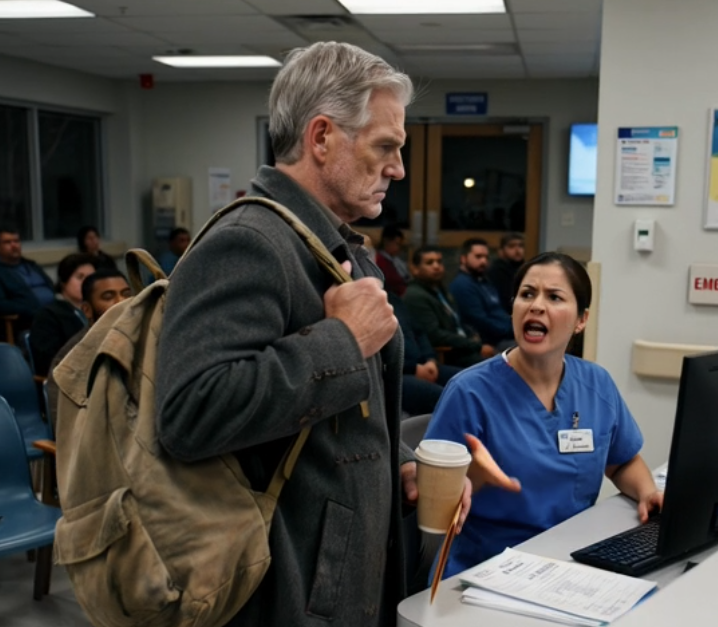
Thomas carefully pushed himself up from the floor.
“I’m sorry,” he said softly. “I didn’t mean to get in anyone’s way.”
The doctor didn’t answer.
His eyes never left the photograph.
Instead, he asked again, his voice quieter this time.
“Where did you get this?”
Thomas smiled faintly.
“I’ve carried it for thirty years.”
The doctor slowly turned the picture around so everyone nearby could see it.
It showed three people standing outside an old county hospital.
A young nurse.
A middle-aged man with tired eyes.
And a little boy, perhaps six years old, sitting on the man’s shoulders, laughing so hard that his head had fallen backward.
The doctor swallowed.
“That little boy…”
“…is me.”
Several staff members looked at him in surprise.
This was Dr. Andrew Collins, the hospital’s Chief of Surgery. Calm under pressure. Brilliant in the operating room. The man who had saved hundreds of lives.
No one had ever seen him look like this.
Thomas looked at him for a long moment.
Then his weathered face slowly softened.
“You’ve grown up.”
Andrew blinked.
“You… know me?”
Thomas nodded.
“I was hoping you wouldn’t remember.”
Andrew took one hesitant step forward.
“My father…”
He stopped.
His voice caught in his throat.
“My father had this photograph.”
Thomas lowered his eyes.
“He gave me a copy.”
The hallway fell silent.
Andrew looked at the back of the picture.
There, written in fading blue ink, were six simple words.
“The day hope came back home.”
His breathing became uneven.
“I’ve seen this handwriting.”
Thomas smiled.
“Your mother wrote it.”
Andrew’s eyes widened.
“My mother died when I was six.”
Thomas looked at him with gentle sadness.
“I know.”
“I was there.”
The nurse who had pushed Thomas stood frozen.
She no longer cared about appearances.
She only wanted to understand.
Andrew took another step.
“Were you… a family friend?”
Thomas shook his head.
“No.”
“I was the janitor.”
Confused whispers spread through the corridor.
Thomas continued quietly.
“Your parents both worked here.”
“Your mother was a nurse.”
“Your father drove the hospital ambulance.”
“They didn’t have much.”
“But they loved you more than anything.”
Andrew felt memories he hadn’t visited in decades begin to stir.
A warm laugh.
The smell of laundry soap.
Someone lifting him onto broad shoulders.
Images that had never quite disappeared.
Thomas reached down and slowly gathered the remaining photographs from the floor.
Each one captured ordinary moments.
Andrew eating ice cream.
Learning to ride a bicycle.
Blowing out birthday candles.
None of them had ever been in his family albums.
Andrew whispered,
“Why do you have these?”
Thomas hesitated.
Then answered honestly.
“Because your father asked me to keep them.”
The doctor’s heart pounded.
“My father?”
Thomas nodded.
“A week before the accident.”
The corridor became impossibly quiet.
Andrew had been told all his life that both his parents had died instantly in a highway collision while driving home from work.
Thomas looked toward the emergency entrance as if seeing another lifetime.
“Your father knew the brakes on the ambulance had been failing.”
“He reported it.”
“Twice.”
“No one repaired them.”
Andrew stared at him.
“What are you saying?”
Thomas sighed.
“The accident wasn’t unavoidable.”
“It was preventable.”
Several staff members exchanged shocked looks.
Thomas continued.
“Your father kept copies of every maintenance report.”
“He wanted someone to be held responsible if anything happened.”
Andrew could barely breathe.
“My family always believed…”
“I know.”
Thomas nodded.
“They were told it was just bad luck.”
He carefully unfolded the same envelope that had fallen moments earlier.
It wasn’t addressed to a patient after all.
It was addressed to:
Dr. Andrew Collins
Andrew frowned.
“You came here for me?”
Thomas smiled.
“I’ve been trying for three years.”
“You were always in surgery.”
“Or at conferences.”
“I didn’t want to interrupt your work.”
“So I waited.”
Inside the envelope were copies of maintenance requests, inspection reports, and a handwritten statement signed by Andrew’s father just days before the fatal crash.
Andrew’s hands shook as he read.
Everything Thomas had said was true.
The brakes had repeatedly failed inspections.
Repairs had been postponed to reduce costs.
The final report contained one sentence underlined twice by his father.
“Someone is going to die if this vehicle isn’t taken out of service.”
Andrew closed his eyes.
His father had predicted his own death.
Not because he wanted sympathy.
Because he wanted someone to listen.
No one had.
The nurse who had humiliated Thomas quietly stepped forward.
“I’m…”
She struggled to find the words.
“I’m so sorry.”
Thomas looked at her kindly.
“Not because you pushed me.”
She looked confused.
“Then why?”
“Because one day another lonely old man will walk through these doors.”
“I hope you see him before you see his clothes.”
Tears filled her eyes.
“I will.”
“I promise.”
Just then, another doctor hurried out of the treatment room.
“The little boy is stable.”
His mother burst into tears of relief.
She looked around until she found Thomas.
“You were trying to return his teddy bear.”
Thomas nodded.
“I thought he’d sleep better with it.”
She walked over and hugged him without hesitation.
“Thank you.”
Andrew watched the scene in silence.
Then he turned toward every employee gathered in the corridor.
“My father spent his life driving patients to this hospital.”
“My mother spent hers caring for them.”
He looked at Thomas.
“And this man spent thirty years protecting the truth because he believed I deserved to know it when I was ready.”
He paused.
“Today…”
“…we failed him before we even learned his name.”
No one could argue.
Andrew turned to the hospital administrator, who had just arrived after hearing the commotion.
“I want every maintenance record from thirty years ago reopened.”
The administrator looked surprised.
“Andrew…”
“No.”
His voice remained calm.
“If negligence caused my parents’ deaths, our hospital’s history deserves the truth.”
The investigation lasted months.
Many of those responsible had long since retired or passed away.
No criminal charges were possible.
But the findings confirmed exactly what Thomas had carried in silence for three decades.
The ambulance should never have been on the road.
The hospital publicly acknowledged its failure and formally apologized to the Collins family.
More importantly, it created a patient safety foundation in memory of Andrew’s parents, dedicated to ensuring that no maintenance concern would ever again be ignored because of budget or convenience.
On the day the memorial plaque was unveiled, Andrew stood beside Thomas.
Reporters gathered nearby, waiting for photographs.
Andrew quietly stepped away from the podium.
He walked over to Thomas and placed the first commemorative pin into his hands.
“You should be standing where I am.”
Thomas smiled.
“I’ve spent my whole life in the background.”
“I’m comfortable there.”
Andrew shook his head.
“My parents gave people hope.”
He gently rested a hand on Thomas’s shoulder.
“But you carried that hope long after they were gone.”
For the first time in years, Thomas’s eyes filled with tears.
Not because history had finally remembered him.
But because a promise made to a grieving father had finally been kept.
As guests began leaving the ceremony, the little boy from the emergency room spotted Thomas sitting alone on a bench.
He ran over, clutching the same worn teddy bear.
“My mom says you’re the nicest man in the hospital.”
Thomas laughed softly.
“I don’t even work here.”
The little boy thought for a second.
Then carefully placed the teddy bear in Thomas’s lap.
“You can borrow him until you come back.”
Thomas looked at the child, then at Andrew watching from a distance.
Some people spend a lifetime searching for proof that kindness matters.
Thomas never needed proof.
He simply lived as though it did.
And in the end, that quiet kindness accomplished something no title, no fortune, and no recognition ever could.
It made sure the truth survived long enough to find the person who needed it most.